
Prevention
Using a Dehumidifier in a Gettysburg Basement: What Actually Helps
A dehumidifier is one of the most useful tools for keeping a Gettysburg basement dry, but it's not a cure-all. Here's how to size one, set the right target, and know when it isn't enough.
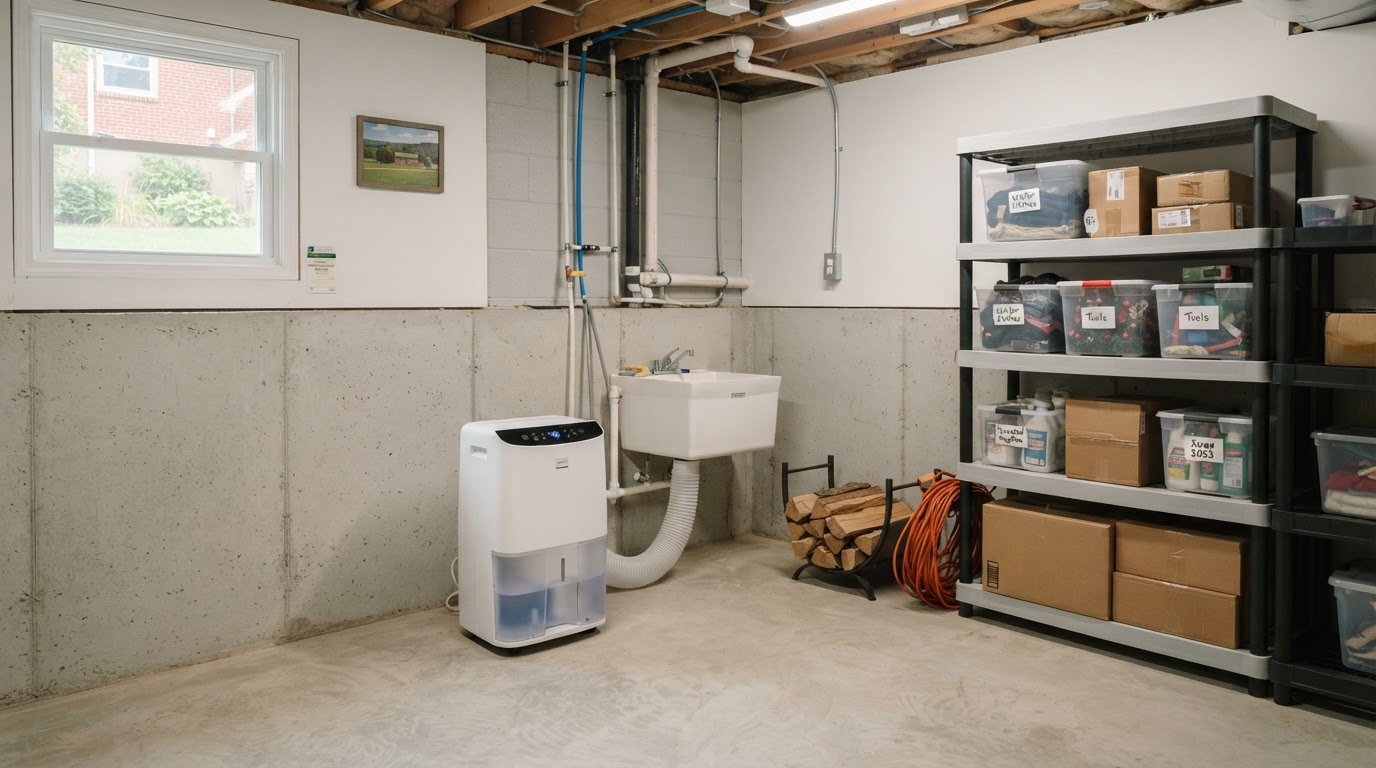
Basements in the Gettysburg area are some of the most common places mold problems start, and a dehumidifier is one of the most effective tools for keeping them dry. But a dehumidifier only does part of the job, and using one wrong — too small for the space, emptied irregularly, or relied on to compensate for an active leak — can give you a false sense of security while mold grows quietly behind a wall.
Why basements here stay damp
Below-grade spaces trap humidity because cool basement walls condense moisture out of warm summer air, and older foundations common in the Gettysburg area — stone, block, or poured concrete built before modern vapor barriers — let ground moisture wick inward. Pennsylvania's humid summers push indoor humidity well above the range where mold can grow, and a closed-up basement is often the last room anyone checks until a musty smell shows up.
Sizing and placement
- Match the unit's capacity (pints per day) to the square footage and how damp the space is. An undersized unit will run constantly and never catch up.
- Place it in the dampest area with airflow around it — not jammed against a wall or behind stored boxes.
- Keep doors and windows closed while it runs; an open basement door lets humid air stream right back in.
Drainage beats emptying a bucket
A dehumidifier with a drain hose or a built-in pump that empties into a floor drain or sump runs unattended. A unit you have to empty by hand only works if someone remembers to empty it — and the moment it fills and shuts off, humidity climbs right back up. If your basement has a floor drain or a sump pit, a continuous-drain setup is almost always worth it.
What target humidity to aim for
Aim to hold indoor humidity below roughly 50–60%. Below that range, most common molds struggle to grow. A cheap hygrometer next to the dehumidifier tells you whether the unit is actually holding the set point or just running without winning. If humidity won't come down even with a correctly sized unit running, that's a sign there's a moisture source the dehumidifier can't keep up with — usually a leak or seepage.
A dehumidifier manages humidity. It does not fix a leak, a crack in the foundation, or a plumbing drip. If you're running one to compensate for an active water source, the mold problem is still growing behind whatever the dehumidifier can reach.
When a dehumidifier isn't enough
If you already see visible growth, smell a persistent musty odor, or have had a water event, a dehumidifier is a support tool, not a solution. Those situations call for finding and fixing the moisture source and, where contamination has taken hold, proper remediation with containment and clearance testing. See our main guide for the full process and the cost factors that drive it.
More From the Blog
Identifying Mold
Mold vs Mildew: How to Tell the Difference in a Gettysburg Home
Mildew is a surface fungus you can often clean yourself; mold penetrates materials and usually needs remediation. Here's how to tell them apart — and why the moisture source matters more than the name.
Read moreWater Damage
What to Do in the First 48 Hours After Water Damage in Gettysburg
Mold can begin growing within 24–48 hours of a water event. What you do in the first two days after a leak or flood in your Gettysburg home shapes whether it becomes a mold problem.
Read moreLooking for the full guide? See our mold remediation Gettysburg PA homepage, or contact us with a question.